Table of Contents
- The Reality of Organic Search in 2026
- SEO Software Comparison: 2026 Architecture & Pricing
- 1. Semrush: Enterprise Keyword Discovery & Visibility Tracking
- 2. Ahrefs: Web-Scale Backlink Graph & SERP History
- 3. Screaming Frog SEO Spider: Desktop Technical Auditing & MCP Integration
- 4. SE Ranking: Cost-Effective Position Tracking & Agency Scaling
- 5. Surfer SEO: Semantic Entity Scoring & On-Page Optimization
- Buyer’s Guide: Evaluating Modern SEO Architectures
- Frequently Asked Questions
- Our Editorial Verdict
The Reality of Organic Search in 2026
Search marketing in 2026 looks nothing like the keyword-density era. Generative AI summaries, conversational search engines, and volatile zero-click results have compressed organic real estate across every commercial vertical. Operating without precision search analytics is a direct route to invisible web pages.
Organic growth demands verified clickstream telemetry, reliable keyword indices, and deep technical site crawling. Platforms that rely on outdated scraping routines will burn your budget on dead-end queries. Readers analyzing technical best seo software reviews need clarity on real operational costs, API constraints, and credit ceilings.
Legacy platforms continue shifting baseline capabilities into expensive tiered add-ons. Hidden seat surcharges, monthly credit consumption traps, and restrictive crawl budgets make selecting the right platform difficult. This guide evaluates five major tools based on documentation, technical architecture, and transparent pricing structures.
Disclosure: This post contains affiliate links. If you use these links to purchase a platform, we may earn an affiliate commission at no extra cost to you. We strictly evaluate software based on technical specifications and public pricing documentation.
SEO Software Comparison: 2026 Architecture & Pricing
The modern SEO tool stack divides sharply between cloud analytics platforms and local technical crawlers. Here is an overview of top-tier platforms, entry pricing, and architecture models.
| Software | Best For | Free Plan / Trial | Starting Price | Rating |
|---|---|---|---|---|
| Semrush | Competitor intelligence & multi-channel marketing | 7-Day Free Trial | $139/mo ($117.33/mo billed annually) | 4.7 / 5 |
| Ahrefs | Backlink exploration & link equity auditing | AWT (Free for verified properties) | $29/mo (Starter) / $129/mo (Lite) | 4.6 / 5 |
| Screaming Frog | Deep technical site crawls & JS rendering | Free (500 URL cap) | $279/year per license | 4.9 / 5 |
| SE Ranking | Agencies & budget-conscious rank tracking | 14-Day Free Trial | $44/mo (billed annually) | 4.4 / 5 |
| Surfer SEO | On-page content optimization & NLP scoring | 7-Day Free Trial (Pro plan) | $49/mo (billed annually) | 4.2 / 5 |
1. Semrush: Enterprise Keyword Discovery & Visibility Tracking
Best for All-in-One Digital Marketing Teams
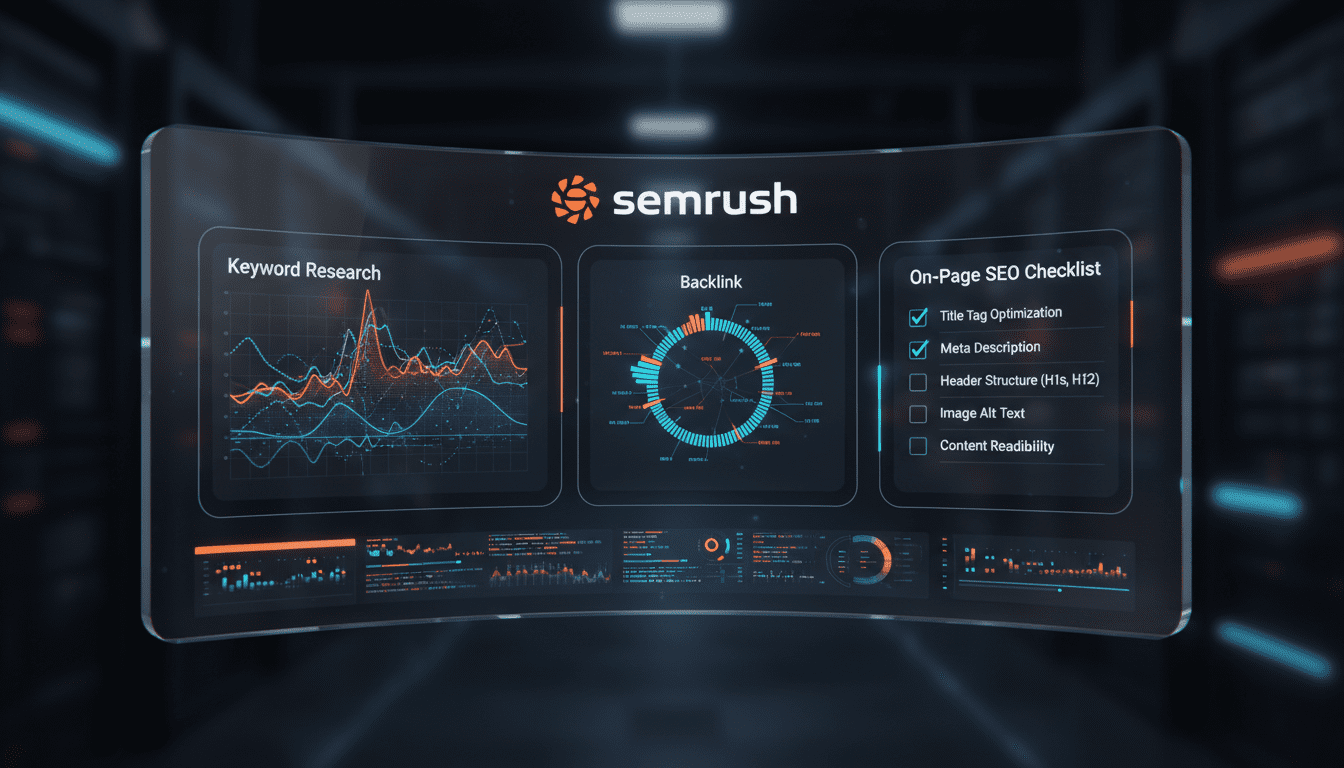
Semrush remains the broadest enterprise marketing ecosystem in organic search. It houses massive keyword databases, deep PPC intelligence modules, competitive domain graphs, and integrated site health audits under a single subscription umbrella. For teams needing end-to-end visibility across search engines, it routinely leads in independent best seo software reviews.
Its primary technical advantage is the Keyword Magic Tool. The platform maintains over 25 billion keywords, structuring queries with intent classifications like Informational, Commercial, Navigational, and Transactional. In addition, its recent updates incorporate AI visibility tracking that monitors brand citations within conversational search interfaces like Perplexity and ChatGPT.
Technical workflows are reliable. The Site Audit suite runs cloud crawls across desktop and mobile user agents, mapping internal linking issues, Core Web Vitals issues, and hreflang errors without putting compute loads on your local workstation. However, data organization can feel heavy, with deep menus that require significant acclimation for non-technical users.
The primary operational friction centers on monetization boundaries. Every standard base tier includes only one user seat. Adding additional team members requires an aggressive recurring fee of +$45 to +$100 per user per month. Specialized toolsets, including Local SEO listings, Traffic Analytics, and the Content Marketing toolkit, also require modular recurring add-ons that inflate monthly overhead.
2026 Pricing & Tier Details
- Standard Entry: $139/month ($117.33/mo billed annually) — 5 projects, 500 keywords tracked daily, 100,000 monthly page crawls.
- Semrush One Starter: $199/month ($165.17/mo annual) — Combines traditional SEO intelligence with automated generative AI presence tracking.
- Pro+ / Advanced Plans: $299/mo to $549/mo — Increases project capacity up to 40 profiles, includes historical archives, Looker Studio connectors, and higher crawl limits.
- API & MCP Integration: Dedicated REST API and Model Context Protocol (MCP) server support requires the Advanced plan ($549/mo) alongside purchased unit bundles.
Pros & Cons
Strengths:
- Massive keyword database with reliable intent tagging.
- Comprehensive PPC ad copy archives and competitor bidding data.
- Robust cloud-native site crawler with scheduled automated reporting.
Drawbacks:
- High seat expansion cost ($45 to $100/seat/mo).
- Modular paywalls for competitive traffic and local citation tracking.
- Dashboard density can slow down daily navigation.
2. Ahrefs: Web-Scale Backlink Graph & SERP History
Best for Link Builders & SERP Forensics
Ahrefs holds an elite reputation among off-page practitioners and technical link architects. Backed by its independent web-crawling infrastructure (AhrefsBot), the platform maps global backlink distribution with precision. It indexes fresh links, redirects, and anchor texts faster than most competing scrapers.
The standout feature is Site Explorer, which delivers clear historical charts covering referring domain velocity, organic page rank progression, and lost backlink records. For competitive audits, the Link Intersect module surfaces the exact domains pointing to competing publications while excluding your own, simplifying outreach campaigns.
SERP history reporting is exceptional. Ahrefs tracks the ranking position of every URL on a search result page going back years, allowing users to isolate algorithm-induced volatility from simple site updates. The recent addition of Brand Radar AI tracks how domains are cited inside generative AI response systems.
However, practitioner communities like r/SEO consistently criticize Ahrefs for its aggressive consumption-based credit system. On Starter and Lite tiers, opening reports, applying query filters, or viewing secondary SERP metrics burns account credits. Exploring data without deliberate planning can rapidly deplete a monthly allocation.
2026 Pricing & Tier Details
- Starter Plan: $29/month — Entry-level access capped at 200 credits monthly; excludes the core rank tracker.
- Lite Plan: $129/month ($1,290/yr annual) — 750 tracked keywords, basic link metrics, and standard daily credit allowances.
- Standard Plan: $249/month — Expands history to 6 months, includes Content Explorer, broken link tracking, and 2,000 tracked keywords.
- Advanced to Enterprise: $449/mo to $1,499+/mo — Unlocks higher usage limits, API endpoints, and team governance tools. Extra seats run +$40 to +$80/mo.
- Free Option: Ahrefs Webmaster Tools (AWT) remains free for verified domain owners via DNS or Google Search Console.
Pros & Cons
Strengths:
- Industry-leading live backlink graph and anchor text tracking.
- Superb historical SERP tracking visualization.
- Free site owner utility via Ahrefs Webmaster Tools.
Drawbacks:
- Credit deductions trigger on basic table filters and views.
- API access is gated behind enterprise tiers and paid tokens.
- No traditional free trial on standard paid tiers.
3. Screaming Frog SEO Spider: Desktop Technical Auditing & MCP Integration
Best for Technical SEO Engineers & Developers
Screaming Frog SEO Spider is a desktop-based technical audit crawler installed locally across Windows, macOS, or Linux environments. Unlike cloud SaaS apps that enforce restrictive monthly crawl quotas, Screaming Frog executes entirely on your local CPU and RAM infrastructure. For enterprise website migrations, redirect validation, and JavaScript rendering, it is indispensable.
When configured to run in Database Storage mode on modern NVMe drives, Screaming Frog easily crawls sites with millions of URLs. It executes JavaScript via an embedded Chromium engine, allowing developers to inspect client-side rendered links, dynamic DOM mutations, and hydration issues. It also integrates directly with Google Search Console, GA4, and PageSpeed Insights APIs.
Recent builds (versions 22 through 23) introduced native LLM API connections (supporting OpenAI, Anthropic, Gemini, and Ollama) alongside Model Context Protocol (MCP) server support. This setup lets engineers programmatically query and extract crawl diagnostics using external AI agents without uploading proprietary data to cloud analytics vendors.
The trade-off comes down to automation overhead and reporting format. Running scheduled recurring crawls requires dedicated cron jobs or headless scripts on private servers (like AWS EC2 instances). Screaming Frog does not generate turnkey, client-facing executive slide decks; it produces detailed technical tables designed for practitioners.
2026 Pricing & Tier Details
- Free Version: Completely free, but strictly hard-capped at 500 URLs per crawl. JavaScript rendering is disabled.
- Paid License: Flat rate of $279/year per license (£199 GBP / €245 EUR per year).
- Volume Licensing: Tiered discounts apply for multi-seat teams (scaling down from $265/user/year for 5+ seats to $235/user/year for 20+).
- Billing Constraints: Single-payment annual license model only; no monthly subscription options.
Pros & Cons
Strengths:
- Unlimited crawl capacity limited only by local hardware resources.
- Flawless Chromium JavaScript rendering execution.
- Direct LLM API and Model Context Protocol (MCP) integration.
Drawbacks:
- Desktop architecture requires dedicated machine resources or VPS.
- Node-locked licensing per workstation.
- No native automated client dashboards or executive summaries.
4. SE Ranking: Cost-Effective Position Tracking & Agency Scaling
Best Value for Boutique Agencies & SMB Portfolios
SE Ranking provides a full-featured cloud alternative for organizations priced out of legacy enterprise platforms. It combines multi-engine keyword position tracking, competitor search analysis, backlink monitoring, and automated website audits at roughly half the monthly cost of tier-one competitors. For budget-sensitive operations, it stands out in modern best seo software reviews.
The platform handles rank tracking exceptionally well. It tracks positioning across Google, Bing, Yahoo, and YouTube across exact geo-locations down to the postal code. You can switch between daily, every-three-days, or weekly check frequencies to conserve account limits, a flexible approach that legacy enterprise platforms omit.
SE Ranking also integrates modern visibility tooling through SE Visible. This feature tracks domain performance across AI search platforms and Generative Engine Optimization (GEO) touchpoints. It also offers a white-label client portal and custom reporting engine on mid-tier plans, making it popular for growing digital marketing agencies.
Its primary technical constraint is backlink index depth. While the database is robust for top-level authority metrics, it does not detect edge-case or newly created referring domains as quickly as Ahrefs. Additionally, Looker Studio connectors and historical archives require mid-to-high tier plans.
2026 Pricing & Tier Details
- Essential / Core: Starts at ~$44 to $55/month (billed annually) — 750 tracked keywords, up to 10 websites, and 40,000 page audit checks.
- Growth: ~$87 to $109/month — Expands keyword limits, unlocks white-label reporting, and includes multi-user access.
- Pro / Enterprise: $189+/month — Tailored for agencies managing large client accounts with high daily keyword checks.
- API Access: Standalone REST API operates via a flexible pay-as-you-go wallet starting at $50/month with MCP server capabilities.
Pros & Cons
Strengths:
- Significantly lower baseline price than enterprise competitors.
- Granular rank tracking down to city and ZIP code levels.
- White-label client reporting included on mid-tier plans.
Drawbacks:
- Backlink discovery velocity lags behind Ahrefs.
- Historical search trends gated on lower-tier subscriptions.
- Looker Studio integration requires upgraded tiers.
5. Surfer SEO: Semantic Entity Scoring & On-Page Optimization
Best for Editorial Teams & Content Optimization
Surfer SEO focuses on on-page semantic relevance and entity coverage. Unlike all-in-one suites that prioritize technical crawling and backlink graphs, Surfer reverse-engineers top-ranking SERP competitors in real time to establish structural baselines for your content.
The foundation of its workflow is the Content Editor. When you query a target phrase, Surfer analyzes natural language processing (NLP) entities, structural elements, heading hierarchies, and word densities from current page-one results. It generates a live Content Score that updates inside Google Docs, WordPress, or its web workspace as writers construct an article.
Surfer also includes an Audit module for existing content. Submitting an underperforming URL generates clear recommendations to add missing semantic entities, address structural gaps, or rebalance keyword distributions. This approach helps lift pages that are technically sound but contextually shallow.
However, Surfer is not a replacement for traditional SEO tools. It provides no backlink discovery, zero technical crawl depth, and limited raw keyword discovery. Treating Surfer as a comprehensive platform will leave gaps in your technical architecture.
2026 Pricing & Tier Details
- Discovery Plan: $49/month (billed annually) / $59/month monthly — Basic content editing for solo creators and niche bloggers.
- Standard Plan: $82/month (billed annually) / $99/month monthly — Higher monthly document quotas, AI visibility tools, and team access.
- Scale & Enterprise: Custom quote (contact sales) — Advanced API access, higher article throughput, and dedicated account support.
- Free Options: A free Chrome extension gives lightweight SERP volume lookups, and a 7-day trial is available on the Pro plan.
Pros & Cons
Strengths:
- Real-time NLP entity analysis based on active page-one competitors.
- Direct integrations with Google Docs, WordPress, and Jasper.
- Quickly identifies entity gaps on underperforming legacy pages.
Drawbacks:
- Lacks backlink monitoring and technical crawl capabilities.
- Strict adherence to entity scores can encourage robotic phrasing.
- Monthly pricing has steadily risen across recent release cycles.
Buyer’s Guide: Evaluating Modern SEO Architectures
Selecting search software requires matching a tool’s core capabilities against your operational bottlenecks. Investing hundreds of dollars each month into enterprise suites with unused features wastes capital. Here is an architectural blueprint to evaluate platforms before committing.
1. Account for Hidden Consumption Ceilings
Legacy subscription models offering flat access to entire databases are rare. Platforms now implement credit tracking systems that consume allowances when you apply filters, query sub-reports, or export spreadsheets. If your workflow involves iterative keyword slicing, ensure your tier handles exploratory volume without racking up overage charges.
2. Cloud SaaS vs. Local Crawler Deployments
Cloud SaaS tools (like Semrush and SE Ranking) handle compute tasks on remote servers. They run scheduled crawls and automatically deliver updates without impacting local hardware. However, cloud crawling becomes cost-prohibitive when monitoring hundreds of thousands of pages. For deep audits, local desktop engines like Screaming Frog eliminate URL restrictions at a fixed annual fee.
3. Generative Engine Optimization (GEO) & MCP Integration
Modern search extends beyond traditional ten-blue-link results. Platforms must track visibility across AI systems like Perplexity, ChatGPT search, and Google’s AI summaries. In addition, teams utilizing AI engineering workflows should check for Model Context Protocol (MCP) server support, enabling local agents to query search data programmatically.
Frequently Asked Questions
What are the primary differences highlighted across best seo software reviews?
Objective software assessments evaluate platforms across four key metrics: backlink index freshness, keyword intent classification, technical crawl depth, and pricing credit structures. All-in-one suites excel at strategic breadth, while desktop engines provide deeper technical crawling at lower costs.
Semrush vs. Ahrefs: Which is the better choice for 2026?


Semrush provides the broader digital marketing suite, incorporating PPC intelligence, content workflow tools, and local business management. Ahrefs remains the gold standard for backlink gap analysis, anchor text tracking, and historical SERP forensics. Pick Semrush for multi-channel marketing, and Ahrefs for dedicated link acquisition.
Can you manage technical SEO using only free software?
Yes, up to a point. Pairing Google Search Console, Screaming Frog (free under 500 URLs), and Ahrefs Webmaster Tools covers basic technical audits and crawl health. However, free tools lack competitive traffic analytics, deep keyword volume tracking, and automated historical rank reporting.
Why use an on-page optimizer like Surfer SEO alongside an all-in-one suite?

General platforms like Semrush identify which queries have commercial opportunity and show who is linking to them. Surfer SEO evaluates how to construct the content by extracting semantic NLP entities and structural layouts from current page-one rankers. They resolve different stages of the content production pipeline.
Our Editorial Verdict 🥇
Which search analytics platform should you deploy?
For organizations needing comprehensive competitor intelligence, keyword research, and client-ready reporting, Semrush is the standard industry choice. Its data breadth justifies the cost for full-funnel marketing teams.
For technical developers and technical SEO specialists, Screaming Frog SEO Spider is unbeatable value. At $279 per year, its local crawling power and native MCP integrations handle heavy technical diagnostics without usage credit walls.

Written by Giorgi Sakandelidze
I research and compare enterprise software platforms using technical documentation, API constraints, and public pricing tiers to help teams build scalable software stacks.
Best SEO Tools: Top Picks for Higher Rankings (2025)

A comprehensive review of the best SEO tools for 2025. We compare top software like Semrush, Ahrefs, and Moz to help you improve your search rankings and traffic.
Price Currency: USD
Operating System: Web, Windows, macOS
Application Category: BusinessApplication
4.9